

What Happens When You Lower the Temperature by One Degree?
In Brief
During April we tested a small reduction in temperature in our HOT yoga rooms. The goal was simple: could we reduce energy consumption without changing the experience of the class?
During the test period we received no spontaneous complaints and one positive comment about the room conditions. Afterwards, 65 participants completed a survey. The results showed broad support for reducing energy consumption and a largely positive or neutral response to a 1°C reduction.
Based on these findings, we have decided to continue with a 1°C reduction and switch off the heating panels during the final 15 minutes of all heated classes. At approximately 37°C, our Original HOT and HOT Hatha classes remain among the hottest yoga classes offered in Utrecht.
Why We Started Looking at This
Across the Netherlands, and especially in the Utrecht region, pressure on the electricity grid is increasing rapidly. As more homes switch to heat pumps, more people drive electric vehicles and more businesses electrify their operations, demand on the electricity network continues to grow. From July 2026, new electricity connections in large parts of the Utrecht region will be restricted because the grid has reached its limits. Grid operators, municipalities and the national government are increasingly asking organisations to think differently about how and when electricity is used, with particular attention to peak hours — typically 07:00–09:00 and 16:00–21:00.
As a yoga community, we asked ourselves a simple question: can we make a small contribution without compromising the quality of the experience? Rather than making assumptions, we decided to test it.
The Experiment
For approximately one month we lowered the temperature in our HOT rooms by about 1°C. We deliberately chose not to announce this change beforehand — we wanted to understand the actual experience before expectations became part of the conversation.
During the test month itself we received no complaints about the lower temperature and one unsolicited positive comment about the room conditions.
Nobody commented that the room felt cold, no questions were raised about the heating, and there were no indications that something fundamental had changed in the experience of the class. Only after we sent a survey to our HOT community did stronger opinions begin to emerge — and that is where things became interesting.
What Our Teachers Told Us
Before starting the experiment, we informed our HOT yoga teachers. Their responses were thoughtful and diverse. Some questioned whether temperature should primarily be determined by energy considerations or by what is needed to achieve the intended therapeutic effect of the practice. Others pointed out that consistency may matter more than the difference between 37°C and 38°C — if a class is meant to be HOT, students should be able to rely on a consistently warm room from the beginning of class.
One teacher raised a different question altogether: not about temperature, but about transparency. If we were experimenting, should participants be informed beforehand? We appreciated all of these perspectives. The experiment was never intended to prove that temperature does not matter. One of the clearest lessons is that it does — what we were exploring was something more specific: how much difference does a 1°C adjustment actually make in practice?
The Survey
After the test period we invited participants to share their thoughts: 478 Invited | 65 Responses | 13.6% Response rate
How Important Is Energy Reduction?
Of all respondents, 56.9% actively support reducing energy consumption. Another 38.5% are neutral. Only 4.6% consider it unimportant.
Very important | 20.0%
Important | 36.9%
Neutral | 38.5%
Not very important | 3.1%
Not important at all | 1.5%
Energy Awareness & Response to a 1°C Reduction
The chart below shows how participants in each energy-awareness group responded to the idea of continuing with a 1°C temperature reduction. The percentages inside the bars reflect each group's share of all respondents.
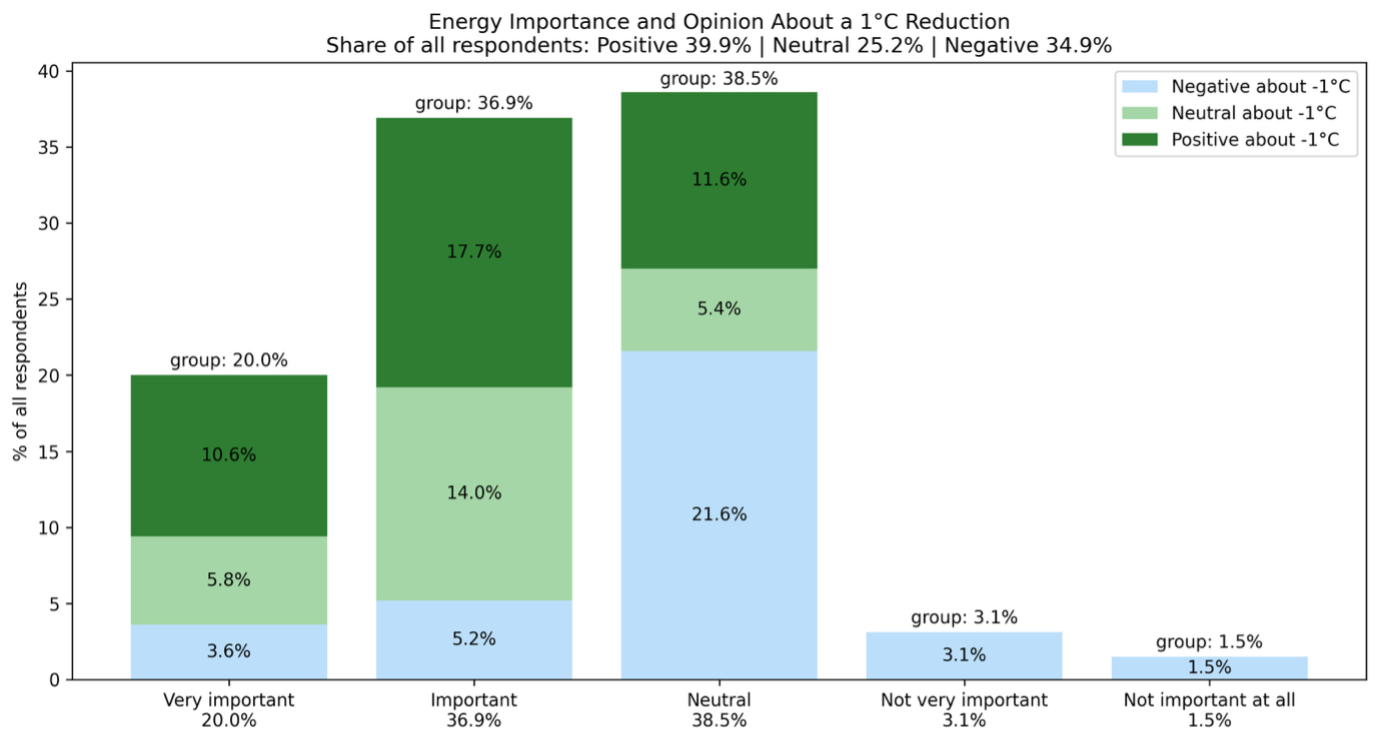
Participants who valued energy reduction were generally positive or neutral about the 1°C change. The strongest resistance came from the smallest groups, while the largest groups — those who find energy reduction important or are neutral about it — were largely open to the adjustment.
A Voice We Also Heard
Following the survey we received one direct complaint from a participant who felt strongly that the lower temperature diminished the Original HOT Yoga experience and expressed concern about continuing to attend. We take that perspective seriously. For some practitioners, heat is not simply a feature of the class — it is one of the main reasons they choose HOT yoga, and that perspective deserves respect. At the same time, it is worth noting that this feedback emerged after participants became aware of the experiment, while no comparable concerns were raised during the testing period itself.
Experience, Expectation and Reality
One of the most interesting observations was that reactions became stronger after participants learned that a change had been made. This does not mean those reactions are less valid. Rather, it suggests that our experience of warmth is shaped by both physical temperature and expectation. Anyone who has practised yoga for a longer period knows that the same room can feel very different from one day to the next depending on energy levels, stress, sleep, hydration and mindset.
HOT yoga is about more than temperature alone. It is also shaped by atmosphere, intensity, routine, expectation and identity. The meaning we attach to the practice influences how we experience it, often more than we realise. In that sense, this experiment became about much more than heating.
What Temperatures Will We Use Going Forward?
Based on the results of the experiment, we will make the following adjustments:
Original HOT from 38°C to 37°C
HOT Hatha from 38°C to C 37°C
HOT Vinyasa from 33°C to 32°C
Inferno HOT Pilates 35°C No change
Warm Classes ≈ 28–32°C No change
The survey also included a specific question about switching off the heating panels during the final 15 minutes of heated classes. 78.5% of participants were either positive or neutral about this, while 21.5% were negative. By the final part of class the room temperature is often already at or above the target temperature due to accumulated heat, so switching off the panels has little noticeable impact on the overall experience. Based on these results, we will switch off the heating panels during the final 15 minutes of all heated classes.
At approximately 37°C, Original HOT and HOT Hatha remain among the hottest yoga classes offered in Utrecht. The intention of these adjustments is not to change the character of the classes, but to reduce energy consumption where possible while maintaining the experience participants value.
Frequently Asked Questions
Does Yoga Moves still offer HOT yoga? Yes. Original HOT and HOT Hatha continue at approximately 37°C and remain among the hottest yoga classes offered in Utrecht.
How much was the temperature reduced? Original HOT and HOT Hatha were reduced from 38°C to 37°C. HOT Vinyasa was reduced from 33°C to 32°C.
Why reduce the temperature? To explore whether energy consumption could be reduced without significantly changing the experience of the class, and because the Utrecht electricity grid is under increasing pressure.
What were the results? During the test month we received no spontaneous complaints and one positive comment. Survey participants were largely positive or neutral about the adjustment.
Are all heated classes changing? No. Inferno Pilates remains at 35°C. Warm classes also remain unchanged.
Will you continue monitoring this? Yes. We will continue to monitor attendance, feedback and room temperatures over time.
A Small Adjustment, A Bigger Conversation
What started as a practical question about energy consumption gradually evolved into a broader conversation about awareness, perception and responsibility. How do we care for the experience we love while also taking responsibility for the world around us? We do not pretend to have all the answers, but we believe these are worthwhile questions for any community that values both wellbeing and conscious living.
Book your HOT or WARM calss below
Thank you to everyone who participated, shared feedback and helped shape this conversation. We would love to hear your experience over the coming months as we continue learning together.